You Won’t Believe This Hidden Urban Gem in Nepal
Patan, Nepal isn’t just another stop on the Kathmandu Valley map—it’s a living maze of temples, alleys, and artisan energy that feels straight out of a dream. I wandered in without a plan and stumbled upon courtyards humming with centuries of history, metalworkers hammering like time stood still, and hidden squares where locals sip tea like nothing’s changed since the 13th century. This city breathes urban soul. If you think Nepal is only mountains and trekking, wait till you see Patan’s streets come alive.
First Impressions: Stepping Into a Living Heritage City
Arriving in Patan from central Kathmandu is like stepping from a storm into a courtyard. The roar of motorbikes, the press of traffic, and the haze of dust fade as the streets narrow and the pace slows. The air shifts—less exhaust, more incense and the faint metallic tang of bronze being shaped in nearby workshops. Underfoot, the uneven stone paths speak of centuries of foot traffic, worn smooth by generations of monks, artisans, and market-goers. There is no grand gate marking the entrance to this ancient city, yet the transition is unmistakable. Patan does not announce itself with fanfare; it reveals itself in quiet details.
What strikes visitors most is not the silence—because Patan is never truly silent—but the rhythm of its sounds. The steady tap of chisels on wood echoes from open-front workshops. Women in colorful saris balance baskets on their heads, exchanging quick greetings as they pass temple gates. Children dart through alleyways, their laughter bouncing off centuries-old brick walls. The city feels dense, layered, and deeply intentional. Unlike modern urban centers built for speed and efficiency, Patan’s design invites pause. Every turn offers a new perspective: a carved window here, a flickering butter lamp there, a glimpse of a shrine tucked between homes.
This is not a preserved relic but a working city where heritage is not observed from a distance but lived daily. The buildings are not museum pieces behind velvet ropes; they are homes, workshops, and places of worship. The wear on the stone steps, the moss in the crevices, the smoke stains on temple eaves—these are not flaws but testaments to continuous use. In Patan, urban life is not about convenience or uniformity. It is about continuity, connection, and a deep respect for what came before. The city’s soul is not in its monuments alone but in the way people move through them, care for them, and belong to them.
The Heartbeat of the City: Durbar Square as Urban Living Room
At the center of Patan lies its Durbar Square—a space so rich in history and activity that it defies the label of tourist attraction. Yes, visitors come to marvel at the intricate temples and the golden gate, but for locals, this square is something far more essential: a living room, a meeting place, a spiritual anchor. At dawn, the first light catches the tiered roofs of the Krishna Mandir and the gilded pinnacle of the Hari Shankar Temple. Monks in maroon robes circle the stone platforms in quiet meditation. Vendors unfold their cloth stalls, laying out marigolds, incense, and small clay oil lamps. By mid-morning, the square is alive with schoolchildren on field trips, their laughter mingling with the soft chime of temple bells.
What makes Durbar Square extraordinary is not just its architecture—though the craftsmanship is breathtaking—but how seamlessly it integrates into daily life. A woman in a sari kneels before a small shrine, offering rice and flowers. Nearby, an old man sips tea from a clay cup, his back against a centuries-old stone pillar. Teenagers gather on the steps of the former royal palace, sharing snacks and stories. The square is not cordoned off for preservation; it is used, loved, and worn. This is not urban space as a monument, but as a shared resource—a place where the sacred and the social coexist without conflict.
The rhythm of the square shifts with the day. Mornings are quiet, devoted to prayer and routine. By afternoon, it becomes a hub of commerce and conversation. In the evenings, as the sun dips behind the hills, families stroll through, children chasing pigeons, elders sitting in clusters, talking softly. The temples, though centuries old, are not frozen in time. They are maintained by local families, their upkeep passed down through generations. Rituals continue uninterrupted, even as tourists snap photos from a respectful distance. This balance—between reverence and routine, between heritage and habitation—is what gives Patan its unique urban character. Durbar Square is not a stage set; it is the stage on which real life unfolds.
Hidden Courtyards and Secret Passages: Patan’s Urban Labyrinth
Beyond the well-trodden paths of Durbar Square lies a network of alleys and courtyards that reveal the deeper soul of Patan. These spaces, known locally as *choks*, are the heart of traditional Newari urban design. Unlike the grand plazas, they are not marked on maps or highlighted in guidebooks. They are discovered by wandering, by turning down a narrow lane, by following the sound of water dripping from a stone spout. Each *chok* is an open courtyard, often centered around a sacred well or a small temple, surrounded by multi-story brick homes with intricately carved windows. These are not tourist attractions but living spaces—places where neighbors gather, where children play, where laundry flaps in the breeze above ancient stone.
Walking through Patan’s labyrinth is an exercise in patience and curiosity. There are no signs, no arrows, no maps that can fully capture the city’s organic layout. The streets twist and turn, sometimes narrowing to barely a meter wide, then opening unexpectedly into a sunlit square. In one alley, you might pass a family preparing a meal on a clay stove, the scent of cumin and garlic filling the air. Around the next corner, a small shrine tucked into a wall holds flickering oil lamps and fresh flower offerings. These moments are not staged; they are simply part of the fabric of the city.
What makes these hidden spaces so powerful is their intimacy. In a world where cities are increasingly designed for visibility and efficiency, Patan’s courtyards remind us of the value of privacy, of quiet, of shared but unspoken understanding among neighbors. A woman might sit on her doorstep weaving, nodding a greeting without breaking her rhythm. A group of men might play cards on a low table, their voices low, their movements slow. These courtyards are not just architectural features; they are social ecosystems, carefully maintained through unspoken rules of respect and coexistence. To walk through them is to witness a different kind of urban life—one built not on speed or spectacle, but on continuity and care.
Craftsmanship as Urban Identity: Art in Everyday Streets
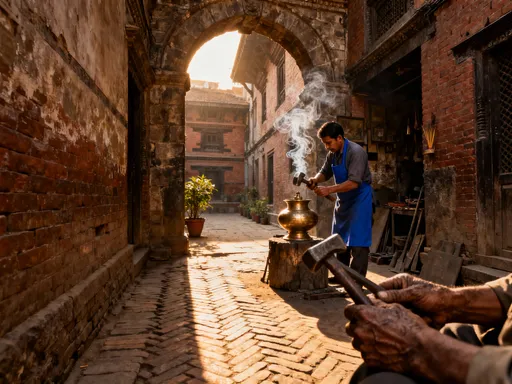
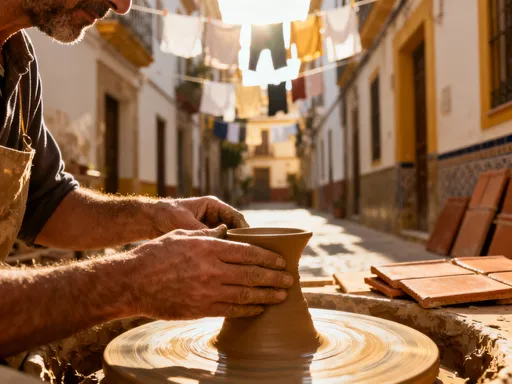
In Patan, art is not confined to galleries or museums. It spills into the streets, shapes the skyline, and defines the city’s identity. For centuries, this city has been a center of metalwork, wood carving, and stone sculpture, with skills passed down through generations of Newari artisans. Today, small family workshops line the alleys, their open fronts revealing men and women bent over their craft, chisels in hand, eyes focused on the delicate work before them. The air hums with the sound of hammers shaping bronze, the scrape of tools on wood, the soft hiss of molten metal being poured into molds.
I met Rajan, a bronze caster whose family has worked in Patan for over 200 years. In his dimly lit workshop, lit only by a single bulb and the glow of his forge, he showed me how a simple clay mold becomes a sacred statue. The process is meticulous: first, a wax model is carved, then encased in clay, baked until the wax melts away, and finally filled with molten metal. Each step requires precision, patience, and deep knowledge. “This is not just a job,” he said, wiping soot from his hands. “It is our duty. Every statue we make carries prayer. Every temple in this city has something made by hands like mine.”
These artisans are not performers for tourists. They are not crafting souvenirs. They are producing sacred objects—idols for temples, bells for monasteries, intricate window grilles for homes—that sustain the spiritual and aesthetic life of the city. Their work is not separate from urban life; it is woven into it. When a temple is damaged in an earthquake, it is these same craftsmen who rebuild it, using the same techniques as their ancestors. When a family builds a new home, they commission carved doors and windows from local woodworkers. Craft here is not a relic of the past but a living, evolving practice that gives Patan its distinctive character. To walk through the city is to see art not as decoration but as necessity.
Public Spaces That Work: How Patan Balances Sacred and Social
One of the most remarkable aspects of Patan’s urban design is how seamlessly sacred and social spaces overlap. Take the *tuns*—traditional stepwells that were once the primary water source for the city. These structures, often built in tiers with stone spouts shaped like lion or elephant heads, are still used today. Women gather in the mornings to collect water, their conversations echoing off the stone walls. Children play on the steps, their feet splashing in the shallow pools. Elders sit in the shade, fanning themselves as they watch the world go by. The *tuns* are not just functional; they are social hubs, places of rest and connection.
Similarly, temple platforms—raised stone bases that support shrines—are not treated as untouchable relics. They are used as benches, as napping spots, as places for children to climb and play. This might seem irreverent to outsiders, but in Patan, it reflects a deep understanding of sacred space as part of daily life. The divine is not separated from the mundane; it is present in both. A priest might chant prayers in the morning, and by afternoon, the same platform hosts a grandmother feeding pigeons. There is no conflict, only coexistence.
This balance is maintained through unspoken but widely understood rules of respect. People remove their shoes before stepping onto temple grounds. They speak softly near shrines. They do not litter or disrupt rituals. But they also do not treat these spaces as off-limits. The result is an urban environment where spirituality is not isolated in temples but integrated into the flow of everyday life. Public space in Patan is not designed for maximum efficiency or commercial use. It is designed for human connection—with each other, with history, and with the sacred. In a world where cities often feel alienating, Patan offers a model of urban living that is both practical and deeply meaningful.
Modern Pressures and Urban Resilience
Like many historic cities, Patan faces challenges from modernization. Tourism has brought economic benefits, but also congestion, noise, and pressure on infrastructure. Some alleys, once quiet and intimate, now see a steady stream of visitors. Traffic, though still limited, is creeping in. New buildings, sometimes poorly designed, threaten to overshadow centuries-old homes. There is a tension between preservation and progress—a struggle to keep the city alive without losing what makes it special.
Yet, Patan is not passively succumbing to change. Community groups, local artisans, and heritage organizations are working together to protect the city’s character. Restoration projects follow traditional methods, using handmade bricks and original techniques. New construction is guided by urban planning principles that respect the scale and style of historic buildings. Educational programs teach young people the value of their heritage, ensuring that craftsmanship and cultural knowledge are not lost.
What is striking is the city’s quiet resilience. Change is happening, but on its own terms. There is no rush to modernize for modernization’s sake. Instead, there is a careful, deliberate approach—preserving the essence of Patan while allowing it to evolve. This is not about freezing the city in time but about ensuring that growth does not come at the cost of soul. The people of Patan understand that their city is not just a collection of old buildings. It is a living culture, a way of life. And they are determined to protect it—not as a monument to the past, but as a home for the future.
Why Patan Changes How You See Cities
Visiting Patan does more than add a destination to your travel list. It changes the way you think about cities themselves. In an era of glass towers, sprawling suburbs, and cookie-cutter developments, Patan stands as a quiet rebellion. It proves that urban life does not have to be fast, loud, or impersonal. It can be slow, layered, and deeply human. Beauty does not require perfection; it thrives in the worn, the used, the lived-in. A cracked stone step, a smoke-stained wall, a chipped carving—these are not flaws. They are marks of a life fully lived.
For travelers, Patan offers a lesson in presence. It asks you to slow down, to look closely, to engage gently. It rewards curiosity and patience. You won’t find it on every itinerary, and that may be for the best. This is not a place to rush through with a checklist. It is a place to wander, to sit, to listen. To see a craftsman shaping bronze, to share a smile with a grandmother on her doorstep, to feel the cool stone beneath your feet—these are the moments that stay with you.
Patan reminds us that cities are not just structures. They are stories. They are shaped by hands, by traditions, by generations of quiet care. They do not need to be shiny or new to be extraordinary. In fact, their power often lies in their age, in their scars, in their ability to endure. In a world that often values the new over the old, the fast over the slow, Patan stands as a testament to a different kind of urban ideal—one rooted in continuity, community, and quiet dignity.
Patan doesn’t shout for attention. It whispers through cracked stone, ringing hammers, and shared glances across a courtyard. This isn’t a museum—it’s a working city where heritage isn’t preserved behind glass but walked on, prayed in, and shaped by hand every single day. In an age of cookie-cutter urban sprawl, Patan stands as proof that cities can be soulful, sustainable, and deeply connected to the past—without sacrificing the pulse of the present. Visit not to check a box, but to remember what urban life can truly feel like.