You Won’t Believe What I Found at Nouakchott’s Hidden Festival
I never expected to fall in love with a city most people can’t even locate on a map. But there I was, standing in Nouakchott, Mauritania, surrounded by color, rhythm, and a warmth I hadn’t felt in years. It wasn’t the grandest festival or the fanciest parade—but it was real. This is a story about stumbling upon a private moment in public celebration, where tradition dances in the dust and joy rises with the desert wind. In a world where every destination seems curated for the camera, this was something different: unpolished, unannounced, and utterly unforgettable. Here, celebration wasn’t about performance. It was about presence—about families gathered under patchwork tents, children laughing between drumbeats, and elders whispering stories older than the dunes. This is the soul of a city few travelers see, and even fewer understand.
Arrival in a City Few Know
Nouakchott does not announce itself with grandeur. There are no towering monuments, no skyline of gleaming glass, no airport banners welcoming visitors with fanfare. Instead, the capital of Mauritania greets newcomers with quiet dignity—low-rise buildings painted in sun-bleached hues, wide sandy streets lined with date palms, and the distant murmur of the Atlantic just beyond the city’s edge. The ocean breeze carries a faint saltiness, mingling with the scent of grilled fish from roadside stands and the occasional whiff of incense drifting from a passing motorbike. It is a city that unfolds slowly, revealing itself not in postcard moments but in quiet observations: a woman balancing a basket of bread on her head, a group of boys kicking a soccer ball through a cloud of dust, the call to prayer echoing from a minaret as the sun begins its descent.
Most international travelers bypass Nouakchott entirely, drawn instead to North Africa’s more famous capitals or the beaches of Morocco and Senegal. This lack of foot traffic is often cited as a drawback, but for those who take the time to stay, it becomes a quiet advantage. Without the pressures of mass tourism, the city remains unaltered—its rhythms dictated not by visitor demand but by daily life. There are no souvenir shops filled with mass-produced trinkets, no guided tours that rush through neighborhoods like checklists. Instead, interaction happens organically. A smile is returned. A question is answered with patience. A shared cup of sweet mint tea becomes the beginning of a conversation that lasts hours.
Yet beneath this unassuming surface lies a cultural depth that surprises even seasoned travelers. Nouakchott is a crossroads—where Saharan nomadism meets coastal livelihood, where Arab, Berber, and West African influences blend in language, cuisine, and custom. It is a city of resilience, having grown from a small village into a national capital in just a few decades, absorbing waves of migration due to drought and regional change. This history has shaped a community that values hospitality, endurance, and quiet pride. To visit is not to witness perfection, but to experience authenticity in its rawest, most honest form.
The Pulse of Festival Culture in Mauritania
In Mauritania, festivals are not spectacles designed for outsiders. They are woven into the fabric of life—moments of communal gathering that reflect both spiritual devotion and cultural continuity. Rooted in Islamic traditions, many celebrations coincide with religious holidays such as Eid al-Fitr and Eid al-Adha, marking times of gratitude, prayer, and family reunion. Yet these observances are deeply intertwined with the country’s nomadic heritage, where oral poetry, music, and shared meals serve as the pillars of social connection. Unlike the flashy carnivals of other regions, Mauritanian festivities are modest in scale but rich in meaning, emphasizing presence over performance and tradition over trend.
Seasonal rhythms also shape the timing and nature of local celebrations. In rural areas, harvest festivals bring communities together to honor the land and its bounty, while in coastal towns, fishing communities mark the beginning of the season with blessings for safety and abundance. Even in Nouakchott, where modern life accelerates daily routines, these traditions persist in homes and neighborhoods, often centered around family compounds or neighborhood mosques. The emphasis is always on togetherness—on breaking bread, reciting poetry, and passing stories from one generation to the next.
Music and poetry, in particular, play a central role in these gatherings. The griot, or iggawen, holds a revered place in Mauritanian society as keeper of history and cultural memory. Through song and verse, they recount lineage, praise community leaders, and preserve the values of honor, generosity, and resilience. These performances are not entertainment in the Western sense—they are acts of cultural preservation, delivered with solemnity and grace. At festivals, their voices rise above the crowd, accompanied by traditional instruments like the ardin (a harp-like string instrument played by women) and the t’beul (a double-headed drum that drives the rhythm). To witness this is to understand that in Mauritania, celebration is not separate from identity—it is a living expression of it.
A Private Invitation into Public Joy
It began with a gesture—simple, unexpected, and deeply human. I had been walking through a residential neighborhood in the evening, drawn by the sound of distant drumming and laughter, when an elderly woman in a flowing m’boubba beckoned me with a smile. Her eyes, lined with years of sun and laughter, held no hesitation—only warmth. In broken French and gestures, she invited me to join her family’s gathering under a large woven tent set up in a courtyard. I hesitated, not wanting to intrude, but her insistence was gentle and firm. This, I would come to understand, is the essence of Mauritanian hospitality: to welcome without condition, to share without expectation.
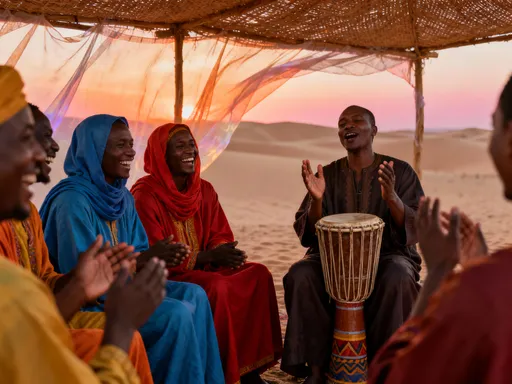
Inside the tent, the air was rich with the aroma of spiced camel meat slow-cooking over charcoal, mingling with the sweetness of dates and the sharp tang of fermented milk. Children darted between seated guests, their laughter rising above the soft hum of conversation. Women in brilliantly colored fabrics sat together, their hands adorned with intricate henna patterns, while elders exchanged stories in Hassaniya Arabic. In one corner, a griot plucked the strings of an ardin, her voice weaving a melody that seemed to stretch back centuries. The atmosphere was not one of performance, but of belonging—of a family marking a moment of joy in the way they always had.
I was given a place near the edge of the circle, handed a small cup of steaming mint tea, and included in the rhythm of the evening. No questions were asked about my origins or purpose. I was simply there, and that was enough. At one point, a young girl offered me a piece of flatbread, her fingers still sticky from honey. When I tried to thank her in my clumsy Arabic, she giggled and ran off, only to return moments later with a plate of dates. These small acts of generosity were not grand gestures—they were the quiet currency of community, exchanged freely and without fanfare. In that moment, I realized that the true heart of a festival is not in its music or food, but in the willingness to open one’s home—and heart—to another.
Music That Speaks Without Words
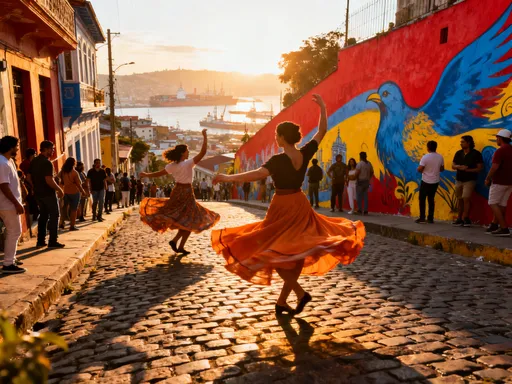
The rhythm began softly, almost imperceptibly—a low pulse from the t’beul drum that seemed to rise from the earth itself. Then came the voice of the griot, clear and resonant, singing in a language I did not understand but felt in my chest. The melody unfolded like a story, each note carrying weight, each pause allowing space for reflection. This was not background music. It was history. It was memory. It was identity made audible. As the tempo increased, a circle began to form—men and women, young and old, stepping forward in a slow, swaying dance that moved like the tide.
I stood at the edge, watching, until a man with a kind face reached out his hand. I hesitated—my movements were stiff, my rhythm uncertain. But as I joined the circle, no one judged. No one laughed. Instead, they adjusted their steps to match mine, guiding me gently through the sequence. The dance was not about precision; it was about participation. It was about moving together, breathing together, becoming part of something larger than oneself. With each turn, I felt the stiffness in my body ease, replaced by a growing sense of connection—not just to the people around me, but to the moment itself.
The t’beul’s beat was hypnotic, its deep resonance vibrating through the ground and into my bones. The griot’s voice rose and fell, recounting tales of ancestors, love, and the vastness of the desert. Even without understanding every word, the emotion was unmistakable. This was how history was preserved—not in books, but in song. Not in lectures, but in rhythm. In a world increasingly dominated by digital records and fleeting content, this was a reminder that some knowledge lives in the body, passed down through movement, melody, and memory. To dance here was not to perform—it was to remember, to honor, to belong.
Colors, Cloth, and Craft in Motion
By morning, the festival had transformed into a quiet marketplace of color and craft. Under a series of shaded stalls, women displayed hand-dyed fabrics in deep indigo, saffron, and crimson—each piece a testament to generations of textile artistry. The m’boubba, the traditional draped garment worn by Mauritanian women, flowed like silk in the breeze, its intricate embroidery catching the light. Some were adorned with gold thread, others with symbolic patterns passed down through families. These were not costumes. They were statements of identity, woven with pride and purpose.
Nearby, artisans sold leather goods—sandals tooled with geometric designs, pouches dyed with natural pigments, and belts embroidered with beads. A young woman demonstrated the art of henna application, her hands moving with practiced ease as she drew delicate floral patterns onto a customer’s palm. The scent of crushed leaves and essential oils hung in the air, mingling with the warmth of the sun. Children watched in awe, already learning the value of skill and patience. This was not a tourist market. There were no price tags in foreign currencies, no vendors calling out for attention. Instead, transactions happened with quiet dignity—barter, conversation, the exchange of trust.
Every item told a story. A leather satchel might have been made by a craftsman from the interior, using techniques learned from his father. A piece of jewelry could carry a family’s protective symbol, worn for good fortune. Even the colors had meaning—indigo for protection, red for vitality, gold for prosperity. To walk through this market was to witness culture in motion, not preserved behind glass but lived in daily practice. There was a beauty in its simplicity, a dignity in its authenticity. In a world where so much is mass-produced and disposable, this was a reminder that true value lies in craftsmanship, intention, and heritage.
Why This Festival Stays Off the Map
Despite its richness, this festival remains absent from travel brochures and international itineraries. There is no official name, no set date, no website. It exists because the community chooses to celebrate—not because visitors expect it. One reason for its obscurity is practical: Mauritania lacks the tourism infrastructure of neighboring countries. International flights are limited, accommodations outside the capital are sparse, and road conditions can be challenging. There is little marketing, few guidebooks, and minimal online presence. For many travelers, the country remains unknown, misunderstood, or overlooked.
But there is another, deeper reason: privacy. The people of Nouakchott do not perform their culture for outsiders. Their traditions are not commodities. They are lived experiences, shared within families and communities, not packaged for consumption. This is not resistance to connection, but a form of protection—a way of preserving authenticity in a world that often reduces culture to spectacle. There is a quiet pride in keeping certain moments sacred, in welcoming guests only when the invitation feels right.
Yet change is coming. Slowly, word-of-mouth travel is shifting perceptions. More independent travelers are seeking out destinations that offer depth over dazzle, connection over convenience. Social media, when used respectfully, has helped share glimpses of these moments—videos of griot performances, photos of handcrafted textiles, stories of unexpected hospitality. Still, the festival remains hidden in the best sense: not lost, but protected. It is a reminder that some of the most meaningful experiences are not found by searching, but by being open—by walking quietly, listening closely, and accepting an invitation when it comes.
How to Experience It Right
For those who wish to witness such moments, the path is not about planning, but about preparation—of heart as much as itinerary. The best time to visit Nouakchott is during the cooler months, from November to February, when the heat is gentle and the air is clear. Religious holidays like Eid al-Fitr often bring spontaneous celebrations, though these are family-centered and not staged for visitors. Harvest festivals in surrounding regions may also offer opportunities for cultural exchange, particularly in coastal or rural communities.
To connect meaningfully, it is essential to engage through local guides—residents who understand both the language and the nuances of hospitality. These individuals can facilitate introductions, explain customs, and ensure that visits are respectful and welcome. Dressing modestly is a sign of respect; for women, this means covering shoulders and knees, often with a light scarf. Men should avoid shorts in residential areas. Always ask permission before taking photographs, especially of individuals or private gatherings. A smile and a gesture go further than a camera.
Patience is perhaps the most important tool. Life in Nouakchott moves at its own pace. Appointments may shift. Conversations may meander. Tea may be served three times before any business is discussed. This is not inefficiency—it is a different rhythm, one that values relationship over speed. To rush is to miss the point. Instead, embrace silence. Listen more than you speak. Accept hospitality when offered, and offer gratitude in return. These moments are not about sightseeing. They are about seeing—and being seen—in return.
Ultimately, the goal is not to witness a festival, but to participate in a moment of shared humanity. It is not about collecting experiences, but about cultivating connection. The most profound travel does not change the destination—it changes the traveler.
True cultural connection does not happen on stage. It happens in courtyards, under tents, in the space between a shared meal and a song passed down through generations. The festival I stumbled upon in Nouakchott was not listed in any guidebook, promoted on any website, or captured fully by any photograph. It existed in the warmth of a stranger’s smile, the rhythm of a drumbeat, the taste of tea sweetened with desert honey. It was not performed for an audience. It was lived—quietly, proudly, and with deep intention. In a world that often equates value with visibility, this was a powerful reminder that some of the most beautiful moments are the ones that remain hidden. And perhaps, that is exactly as it should be. To those willing to look beyond the usual destinations, to listen with humility and open their hearts, such moments await—not as attractions, but as invitations. The world is full of unseen wonders. All we need is the courage to accept them when they come.